


The Role of a Martial Arts Teacher in Madison's Zhong Yi Kung Fu Association

Updated: Jan 18

Within the Zhong Yi Kung Fu Association, the role of a martial arts teacher reflects the traditional concept of the Quán Tóu Shī (拳頭師 - lit. fist pattern teacher). A teacher does not simply instruct physical movements; they also transmit the fighting methods, discipline, ethics, and cultural knowledge of Chinese martial arts. This holistic approach emphasizes both personal development and service to the community.
The Historical Context of Martial Arts Teaching
Historically, martial arts teachers possessed a broad range of skills beyond combat. In keeping with this tradition, the ZYKFA recognizes the close relationship between martial arts, performance arts, and cultural practices. Many traditional teachers were knowledgeable in Lion Dance and Dragon Dance, folk rituals, and elements of traditional Chinese medicine such as acupuncture, moxibustion, and tuina. These skills supported not only martial training but also the physical well-being and cultural continuity of the community.
Martial Arts and Community in Chinese Tradition

During the Qing Dynasty (清, 1644–1911), village elders commonly arranged for young members of the community to study martial arts under a local or visiting teacher. Training served multiple purposes: defending the village, cultivating discipline and character, and preparing students to participate in temple and festival performances. Martial arts troupes demonstrated skills such as Lion Dance (舞獅), Dragon Dance (舞龍), Song Jiang Battle Formation (宋江陣), and other folk performance traditions. These activities strengthened community identity and preserved cultural heritage.
Martial arts were particularly influential in Taiwan during the Qing period, where schools were established to meet the needs of personal safety, community defense, and cultural expression. A martial arts school might be led by a teacher/master (Shifu 師傅 or 師父), or by a patron or administrator (Guǎn Zhǔ 館主) who supported and maintained the training hall. Some schools functioned as family traditions, passing ancestral arts from generation to generation, while others began as private instruction within households and later developed into village or town martial arts halls. The ZYKFA carries forward this legacy in a modern, professionally operated environment that remains open and welcoming to the broader community.
Teaching, Training, and Transmission
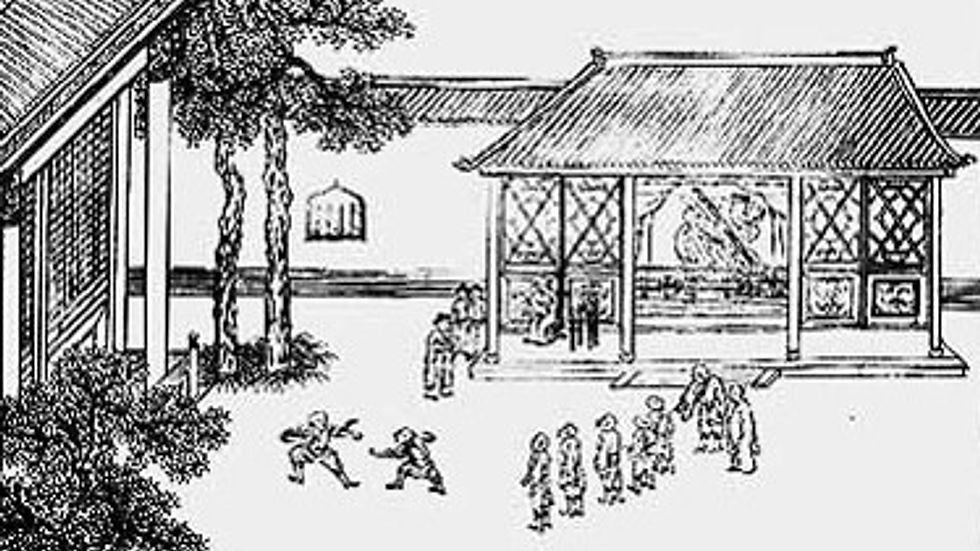
In traditional settings, villages often invited teachers from outside the community to establish training. Over time, dedicated students developed the skills and character necessary to become instructors themselves, ensuring the continuity of the art. Teachers frequently taught in multiple locations, and students followed a variety of paths, becoming teachers or remaining lifelong practitioners dedicated to preserving and supporting the tradition.
In agricultural societies, martial arts training often took place in courtyards, village centers, or communal halls. Instruction included fighting theory (拳理 Quánlǐ), forms (拳套 Quán Tào), weapons training (兵器 Bīngqì), and practical self-defense (自衛). Itinerant teachers were expected to possess additional skills, including traumatology (跌打), herbal knowledge, and basic medical care. Many also understood folk rituals, traditional Chinese medical practices, and, in some cases, Feng Shui (風水) and the selection of auspicious dates.
ZYKFA’s Living Tradition
The Zhong Yi Kung Fu Association honors this historical model while adapting it to modern life. Training at the ZYKFA emphasizes traditional martial arts, performance arts such as Lion and Dragon Dance, and the values of respect, discipline, and community responsibility. Students are encouraged not only to develop physical skill but also to contribute to cultural preservation, public performances, and mutual support within the school and the broader community.
Through structured instruction, cultural education, and hands-on experience, the ZYKFA continues the time-honored process of transmission—ensuring that Chinese martial arts remain a living tradition, passed from teacher to student, generation to generation.
The Importance of Community Engagement
Engaging with the community is vital for the ZYKFA. We believe that martial arts can foster friendships and create a sense of belonging. By participating in local events, we not only showcase our skills but also share our culture. This connection helps us grow as individuals and as a community.
The Benefits of Practicing Martial Arts
Practicing martial arts offers numerous benefits. It enhances physical fitness, improves mental focus, and builds self-discipline. But beyond these personal gains, martial arts can also promote peace and harmony within the community. When we train together, we learn to support one another, fostering a spirit of camaraderie.
Conclusion: A Path Forward Together
As we move forward, let’s embrace the teachings of our martial arts heritage. Each class, each performance, and each interaction is an opportunity to strengthen our bonds and enrich our lives. Together, we can ensure that the traditions of Chinese martial arts thrive in Madison and beyond.
Let’s continue to learn, grow, and support one another on this journey. Remember, the path of martial arts is not just about self-defense; it's about building a community rooted in respect, understanding, and shared values.
In this spirit, I invite you to join us at the ZYKFA and experience the beauty of Chinese martial arts firsthand. Let's create a vibrant community together!


Comments